


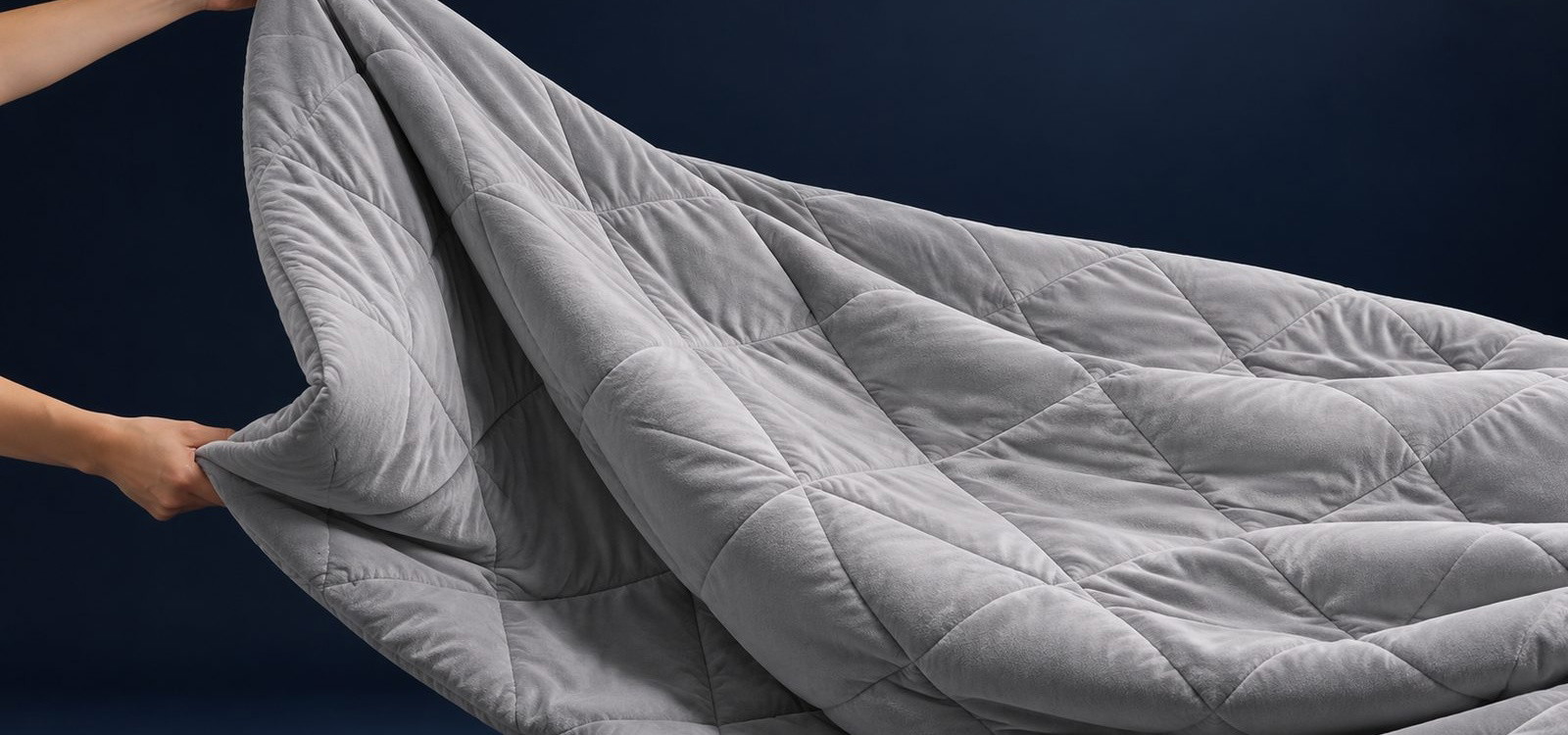
Pick up a weighted blanket in a store and the first question is almost always the same: how heavy should it be? Too light and it feels like an ordinary comforter. Too heavy and it can feel confining. The most common answer is a rule of thumb, about 10 percent of your body weight, and it is a reasonable place to start as long as you understand what it is and what it is not.
Key points
- About 10 percent of body weight is a rule of thumb based on users' preferences, not on clinical trials.
- Preferred weights range roughly 5 to 12 percent; if you fall between weights, starting lighter is usually easier.
- Weighted blankets aren't for infants or young children; check with a doctor if you have certain medical conditions.
- A 2020 Swedish trial reported promising results in one specific group, but it was relatively small and short.
Where the 10 percent rule comes from
The Sleep Foundation states the rule plainly: as a rule of thumb, a weighted blanket should weigh about 10 percent of your body weight. It adds that preferred weights vary between roughly 5 and 12 percent of the sleeper's weight.
What the rule is not is the result of a clinical trial that tested different percentages against each other. The Sleep Foundation notes that its own weight recommendations are based on current users' general opinions and preferences. In other words, 10 percent is a widely shared convention that matches what many people find comfortable: heavy enough to feel a gentle, even pressure, light enough to turn over and push off easily.
That is why it is better to treat the number as a midpoint. If you dislike feeling pinned, move toward the lighter end. If you like a firm, enveloping feel and have no medical reason to be cautious, you can move up a little.
A blanket you can comfortably use every night is more useful than a heavier one that ends up folded at the foot of the bed.
A simple weight chart
The table below applies the 10 percent rule and the 5 to 12 percent comfort range to common adult body weights. Velin's Stillweight Weighted Blanket comes in two weights, 15 lb and 18 lb, noted where they fit.
| Your body weight | About 10% | Comfortable range (5–12%) | Stillweight fit |
|---|---|---|---|
| 100–125 lb | 10–12 lb | 5–15 lb | 15 lb is at the heavy end; try it only if you like firm pressure |
| 125–165 lb | 12–16 lb | 6–20 lb | 15 lb |
| 165–200 lb | 16–20 lb | 8–24 lb | 18 lb |
| 200–250 lb | 20–25 lb | 10–30 lb | 18 lb, a little under 10% but well within range |
| Over 250 lb | 25 lb and up | 12.5 lb and up | 18 lb sits at the lighter end |
Ranges are rounded. Comfort varies, and these figures are a starting point rather than a prescription.
If you fall between two weights, most people find it easier to start lighter. A blanket you can comfortably use every night is more useful than a heavier one that ends up folded at the foot of the bed.
Size, fill and heat
Size is not the same as weight
A weighted blanket is meant to rest on you, not drape over the sides of the mattress. If it hangs off the edge, gravity pulls part of the weight toward the floor, and the blanket can slide off in the night. For that reason, weighted blankets are usually cut closer to body size than a comforter of the same bed size.
Stillweight comes in 54" x 72" at 15 lb and 60" x 80" at 18 lb. The smaller size covers one adult comfortably; the larger gives more room to move. If you share a bed, it usually works better for each person to have their own blanket at their own weight, since a single blanket chosen for one body will be too heavy or too light for the other.
Glass microbeads or plastic pellets
According to the Sleep Foundation, most weighted blankets are filled with either plastic pellets or glass microbeads. Glass is denser, so it takes less volume to reach the same weight, which tends to make a thinner, less bulky blanket. Manufacturers and reviewers also commonly describe glass beads as smoother and quieter when they shift. Plastic pellets are generally less expensive.
Just as important as the fill is how it is held in place. Small quilted pockets keep beads from drifting to one end, so the weight stays evenly spread. Stillweight uses glass microbeads sewn into small quilted pockets for this reason, and the blanket is OEKO-TEX STANDARD 100 certified, meaning its materials have been tested for harmful substances by an independent lab.
Heat
Any blanket with this much material adds warmth. The Sleep Foundation notes that the material and fill play a role in how hot a weighted blanket sleeps. If you run hot, keep the bedroom cool, use the blanket over a light sheet rather than on top of a duvet, and expect to use it less in midsummer. Our guide on how to sleep cooler without cranking the AC has more ideas for warm nights.
Covers
Because a weighted blanket is heavy, washing the whole thing is a chore, and some are not designed for it. A removable cover solves that. The Stillweight Blanket Cover, also OEKO-TEX STANDARD 100 certified, is a soft minky cover that machine washes cold and tumbles dry on low, while the blanket itself is spot clean only. You can see both on the Stillweight Weighted Blanket page.
From the Stillweight collectionStillweight Weighted BlanketGlass microbeads sewn into small quilted pockets, in 15 lb and 18 lb weights. OEKO-TEX STANDARD 100 certified.View productWho should not use one
Weighted blankets are not for everyone, and this part matters more than any weight chart.
- Infants and young children. The American Academy of Pediatrics' 2022 safe sleep recommendations state that weighted blankets, sleepers, swaddles and other weighted objects should not be placed on or near a sleeping infant. In a 2023 letter to the U.S. Consumer Product Safety Commission, the AAP said there is no peer-reviewed evidence that these products are safe for typical, healthy infants. For older children, the Sleep Foundation suggests weighted blankets are generally considered safe from age 3 and at least 50 pounds, and recommends talking to a family physician first. Stillweight's 15 lb and 18 lb weights are not meant for children.
- People with certain medical conditions. The Sleep Foundation advises talking to a doctor before using a weighted blanket if you have a respiratory disorder, obstructive sleep apnea, low blood pressure or type 2 diabetes, noting that a blanket that is too heavy can make breathing more difficult. If you have a circulatory condition, or any condition that affects your ability to move or lift the blanket off yourself, ask your doctor first.
- Anyone who feels claustrophobic. The Sleep Foundation notes that weighted blankets may not suit people who tend to feel confined.
A simple rule for everyone: you should always be able to move the blanket off yourself easily, without help.
What the research says
The best-known study is a randomized controlled trial by Bodil Ekholm, Stefan Spulber and Mats Adler, published in the Journal of Clinical Sleep Medicine in 2020. Researchers in Sweden assigned 120 adults with insomnia and a psychiatric diagnosis (depression, bipolar disorder, generalized anxiety disorder or ADHD) to sleep for four weeks under either a heavy metal-chain blanket, about 8 kg (roughly 18 lb, or 6 kg for those who found 8 kg too heavy), or a light plastic-chain blanket of about 1.5 kg.
On the Insomnia Severity Index, a standard questionnaire, average scores fell from 21.7 to 9.2 in the weighted group and from 21.2 to 18.8 in the control group. About 59 percent of the weighted group met the study's definition of response, compared with about 5 percent of the control group. Wrist activity monitors did not show a significant change in total sleep time across the weighted group as a whole.
The study has real limits. It was relatively small and short, it involved people with specific psychiatric conditions rather than the general public, a heavy blanket is hard to disguise as a light one, and the authors noted the lack of sleep diaries or overnight lab recordings. The blankets were chain blankets, not bead-filled ones. The findings are promising for that group, but they do not show that any weighted blanket, including ours, treats insomnia or any other condition. Researchers are still working out who benefits, and why.
Getting used to the weight
The first few nights can feel unfamiliar. A few ways to ease in:
- Start on the sofa. Use the blanket for 20 or 30 minutes while you read or watch something, so the feeling becomes familiar before you sleep under it.
- Try it for part of the night. Some people begin by using it until they fall asleep, then pushing it aside.
- Give it a week or two. Your sense of what feels comfortable often settles after several nights.
- Adjust if needed. If you still feel restricted after a fair trial, a lighter blanket is a better answer than forcing it.
If you are ready to try one, the Stillweight Weighted Blanket comes in 15 lb and 18 lb, with the Stillweight Blanket Cover for easy washing.
Sources
- Sleep Foundation. "Weighted Blanket Weight Chart." sleepfoundation.org
- Ekholm B, Spulber S, Adler M. "A randomized controlled study of weighted chain blankets for insomnia in psychiatric disorders." Journal of Clinical Sleep Medicine, 2020;16(9):1567–1577. PMC7970589
- American Academy of Pediatrics. Letter to the U.S. Consumer Product Safety Commission and ASTM International on weighted infant products, June 15, 2023. downloads.aap.org
This article is for general information and isn't medical advice. Individual results vary.
