


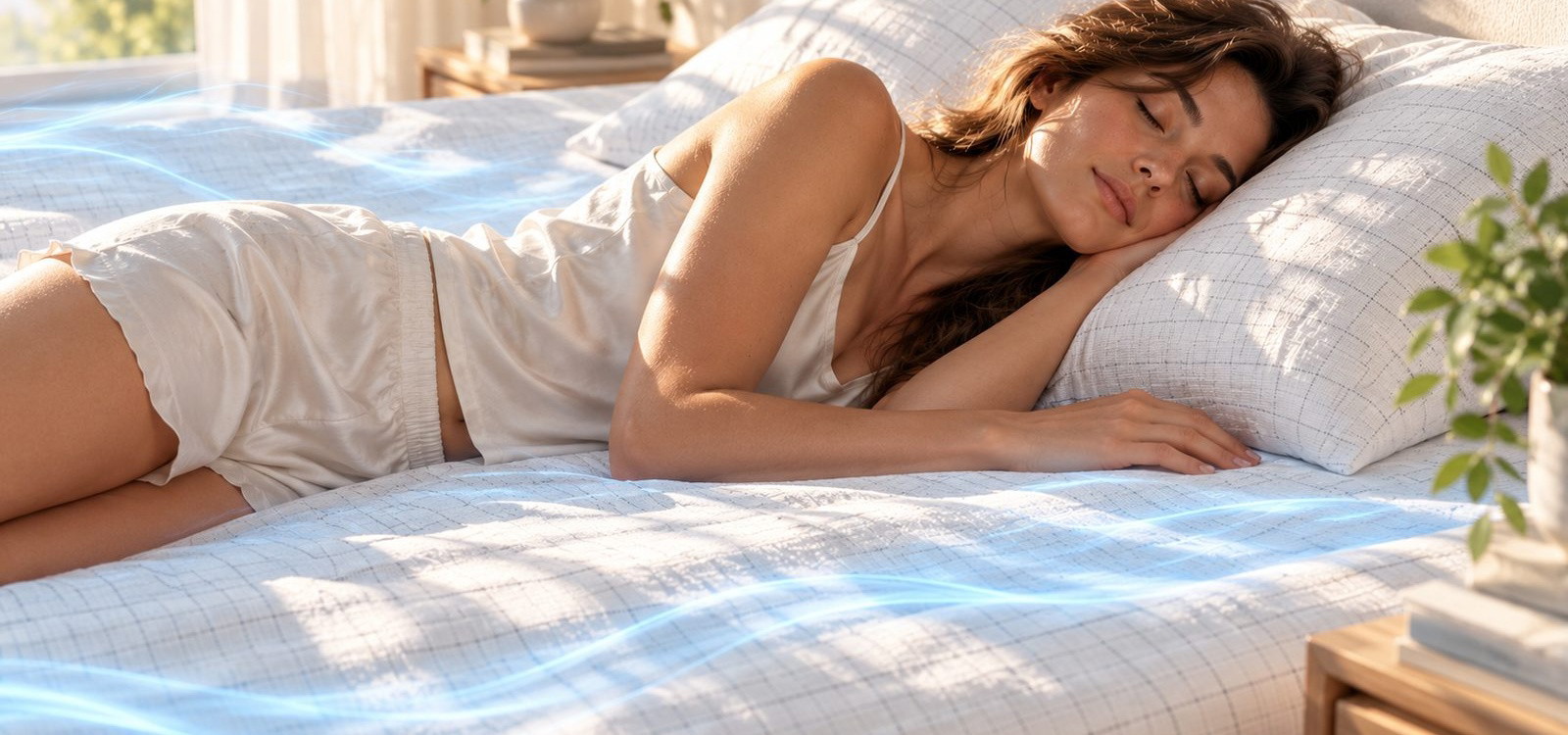
It is midnight, the sheets feel warm wherever you touch them, and you have flipped the pillow twice. Heat is one of the most common reasons people lie awake in summer, and the fix is not always a colder thermostat. Much of it comes down to helping your body do something it already wants to do: cool down.
Key points
- Core body temperature falls before bedtime; the Sleep Foundation suggests a bedroom around 65°F, though preferences vary.
- Breathable natural fibers, a percale weave and adjustable layers help heat leave the bed.
- One meta-analysis associated a warm bath or shower one to two hours before bed with falling asleep faster.
- Shade windows by day, move air at night, and use separate top layers when sharing a bed.
Why temperature and sleep are linked
Your core body temperature follows a daily rhythm. According to the Sleep Foundation, it begins to fall roughly two hours before your usual bedtime, alongside the evening rise in melatonin, and keeps dropping to a low point in the early morning hours. The body sheds that heat mostly by widening blood vessels in the hands and feet, which is why your feet can feel warm just as you are getting drowsy.
A hot room or a heat-trapping bed works against that process. The Sleep Foundation suggests a bedroom of about 65°F (18.3°C), within a broader range of 65 to 68°F, while noting that individual preferences vary by a few degrees. Infants are an exception: the same source suggests their room may be a degree or two warmer, up to 69°F, and warns that overheating is a risk for babies.
If 65°F is out of reach on your power bill, the goal is still the same. Every change below helps heat leave your body and your bed a little more easily.
Start with the bed itself
Bedding is where you sleep, so it often matters as much as the air in the room.
Fiber
Natural fibers such as cotton and linen tend to breathe better than synthetics. In a Sleep Foundation guide to cooling down a foam mattress, psychologist Sarah Silverman, Psy.D., recommends breathable natural fibers and notes that "synthetic fibers tend to be less breathable and trap more heat at night." If your current sheets are standard polyester and you run hot, they are a sensible first thing to swap.
Weave
Two cotton sheets can feel very different depending on how they are woven. Percale uses a simple one-over, one-under weave that leaves a crisp, matte surface; the Sleep Foundation calls it highly breathable and often the best choice for hot sleepers. Sateen floats more yarn on the surface for a silkier hand and a little sheen, and the same source says it may be more likely to trap heat. Percale wrinkles more easily, which is the trade-off.
Twill is the third common weave. Each row offsets the over-and-under pattern, which forms fine diagonal ribs called wales. With fewer interlacings than percale, the yarns have a little more room to move, which tends to give twill a softer, more fluid drape, and the diagonal texture can make creases less visible. As with any weave, how cool a twill sheet sleeps depends on the fiber, the yarn and how densely it is woven.
Velin's Equilibrium sheets are woven from GOTS certified organic cotton, a natural fiber. Our SilverThread Sheets use GOTS certified organic long-staple cotton in a twill weave. You can read more about how we choose materials on The Materials.
Layers, not one heavy cover
One thick comforter gives you two settings: on or off. A flat sheet plus a light cotton or linen blanket, with a heavier layer folded at the foot of the bed, lets you adjust through the night as your temperature drops toward morning.
A note on weighted blankets: they add a layer of mass and fabric, and they are not the right choice for most people on a hot night. If you love your Stillweight Weighted Blanket and naturally run cool, it may still work for you. If you are already kicking off the covers, save it for cooler months. We cover weight and heat in more detail in How to choose the right weight for a weighted blanket.
The mattress
Mattresses hold heat too. The Sleep Foundation describes memory foam as notorious for trapping body heat, because its dense structure breathes poorly and its body-hugging shape absorbs warmth. You cannot change the foam, but breathable sheets and a mattress pad or topper designed for airflow can help. If you are shopping for a new mattress anyway and sleep hot, it is worth asking how the model handles heat.
From the Equilibrium collectionEquilibrium Grounding Fitted SheetWoven from GOTS certified organic cotton, a natural fiber, at 400 thread count with conductive silver fiber.View productUse timing to your advantage
It sounds backward, but a warm shower or bath before bed can help you cool down. In a 2019 systematic review and meta-analysis in Sleep Medicine Reviews, Shahab Haghayegh and colleagues at the University of Texas at Austin screened more than 5,300 studies and analyzed 17 that met their criteria. They reported that bathing or showering in water of about 104 to 109°F (40 to 42.5°C), one to two hours before bedtime, was associated with falling asleep faster, even when the bath lasted as little as 10 minutes.
The proposed explanation is that warm water draws blood to the hands and feet, which then release heat and help the core temperature fall. The authors were careful to say that the research is limited, particularly on the best timing and duration and the exact mechanism, and the included studies involved quite different groups of people. The Sleep Foundation gives similar advice: a warm bath an hour or two before bed.
Evening drinks matter as well. A review in the journal Alcohol by Mahesh Thakkar and colleagues at the University of Missouri describes a familiar pattern: alcohol can help people fall asleep faster and sleep more deeply early on, but sleep tends to be disrupted in the second half of the night. If you are waking at 3 a.m. feeling warm and restless, a nightcap may be part of the reason. A glass of water at the bedside is a simpler companion.
Manage heat during the day
A bedroom that bakes in the afternoon sun will still be warm at midnight. The Sleep Foundation suggests closing blinds during the day to limit heat buildup. Blackout curtains or shades on sun-facing windows help twice: they keep heat out in the afternoon and keep early light out in the morning.
Other daytime habits that add up:
- Run heat-producing appliances such as the oven and dryer earlier in the day, or not at all on the hottest evenings.
- Switch off electronics and lamps you are not using in the bedroom; they all give off a little heat.
- If you have a choice of rooms, the Sleep Foundation notes that a lower floor is usually cooler in summer.
Move the air
Moving air helps sweat evaporate, which is how skin cools itself. A fan will not lower the room's temperature, but it can make the same temperature feel more comfortable. A few ways to get more from one:
- Once the outdoor air is cooler than the indoor air, typically late evening, open windows on opposite sides of your home and set a fan in one to push warm air out.
- Aim a fan across the bed rather than straight at your face if a direct draft dries your eyes or throat.
- Ceiling fans should spin so you feel a breeze standing beneath them; most have a switch to change direction for summer.
The Sleep Foundation also mentions controlling humidity. Humid air slows evaporation, so a dehumidifier can make a warm room feel noticeably less sticky.
Share the bed thoughtfully
Other bodies are heat sources. A partner, a child who climbs in at 2 a.m. or a dog curled against your legs all add warmth you did not plan for. A few practical fixes:
- Use separate top layers. Two lighter blankets let each person set their own temperature, and the person who runs hot can skip one entirely.
- Give pets their own bed on the floor during heat waves, or at least a spot at the foot of the bed.
- Choose a bed large enough that you are not touching all night, if that is an option.
A fan will not lower the room's temperature, but it can make the same temperature feel more comfortable.
Putting it together
None of these changes is dramatic on its own. Together, they can make a real difference: breathable cotton or linen in a percale weave, layers you can shed, a warm shower an hour or two before bed, shaded windows during the day and a fan moving air at night. If you would like to see what Velin makes, start with Find your starting point.
And if you are consistently waking hot and drenched despite a cool room, mention it to your doctor. Night sweats can have causes that bedding cannot fix.
Sources
- Sleep Foundation. "Best Temperature for Sleep." sleepfoundation.org
- Sleep Foundation. "Sateen vs. Percale." sleepfoundation.org
- Canvas ETC. "Twill Fabric: Weave Structure, Types, Uses, and Specifications." canvasetc.com
- Sleep Foundation. "How to Make a Memory Foam Mattress Sleep Cooler." sleepfoundation.org
- Haghayegh S, Khoshnevis S, Smolensky MH, Diller KR, Castriotta RJ. "Before-bedtime passive body heating by warm shower or bath to improve sleep: A systematic review and meta-analysis." Sleep Medicine Reviews, 2019.doi.org/10.1016/j.smrv.2019.04.008
- University of Texas at Austin, Cockrell School of Engineering. Coverage of the Haghayegh et al. review. cockrell.utexas.edu
- Thakkar MM, Sharma R, Sahota P. "Alcohol disrupts sleep homeostasis." Alcohol, 2015;49(4):299–310. PMC4427543
This article is for general information and isn't medical advice. Individual results vary.
