


For one summer week, a small group of adults left their phones and flashlights behind and went camping in the Colorado mountains, with only sunlight and campfires for light. By the end of the week, their body clocks had shifted earlier, lining up closely with sunrise and sunset. The study was small, but it makes a point sleep researchers return to often: when light reaches your eyes matters, and modern life tends to give us the wrong amounts at the wrong times.
Key points
- According to NIGMS, light and dark most influence circadian rhythms; evening light pushes against melatonin's rise.
- A 2018 review linked brighter morning light to an earlier sleep period, and brighter evening light mostly to the opposite.
- Consensus recommendations suggest bright daytime light, dimmer light at least three hours before bed, and a dark bedroom.
- Open the curtains in the morning, dim and warm the lights after dinner, and wind down screens.
Here is how light timing works on the body, and how to put that knowledge to use without any special equipment.
How light sets the body clock
According to the National Institute of General Medical Sciences (NIGMS), part of the National Institutes of Health, circadian rhythms are the physical, mental and behavioral changes that follow a roughly 24-hour cycle. A master clock in the brain, a cluster of nerve cells called the suprachiasmatic nucleus, keeps those rhythms in step. NIGMS says that light and dark have the biggest influence on them.
One way that signal works is through melatonin, a hormone linked to sleep. NIGMS explains that the master clock controls melatonin production based on how much light the eyes receive, and that melatonin rises in the evening, which helps make us sleepy. Light in the evening pushes against that rise. The Sleep Foundation notes that blue light in particular suppresses melatonin, and that evening exposure can trick the brain into thinking it is still daytime.
The camping study, by Kenneth Wright and colleagues and published in Current Biology in 2013, showed this in daily life. With electric light, the eight participants got less sunlight during the day and more light after dark, and their internal clocks ran later. With only natural light, the start of their biological night moved close to sunset. The researchers tracked just eight people for a single summer week, so it's a snapshot, not a rule.
What the research says about morning and evening
A 2018 systematic review in Sleep Health, led by Natalie Dautovich, looked at 45 studies on light and sleep in adults living at home. Overall, brighter morning light was linked to an earlier sleep period, such as falling asleep faster and waking earlier, and to better self-reported sleep. Brighter evening light was mostly linked to the opposite: taking longer to fall asleep, a later sleep period and worse self-reported sleep.
The authors call these broad trends rather than firm rules. The studies used different methods, most compared bright light with dim light, so the right "dose" is largely unknown, and few controlled for color or how long the light lasted.
Light right before bed also has a measurable effect. In a 2011 study in the Journal of Clinical Endocrinology & Metabolism, Joshua Gooley and colleagues reanalyzed data from 116 healthy adults aged 18 to 30 who stayed in a research unit. Compared with dim light, ordinary room light (under 200 lux) in the hours before bed delayed the evening rise in melatonin in nearly all participants and shortened its duration by about 90 minutes. The participants were young and healthy and lived in a controlled setting, so the results may not translate directly to every home.
Lux, in plain terms
Lux measures how much light falls on a surface. You don't need a meter to use the idea, but a few reference points help. The Sleep Health review lists these approximate levels:
| Setting | Approximate light level |
|---|---|
| Direct sunlight | More than 100,000 lux |
| Overcast day | About 1,000 lux |
| Indoor office | About 500 lux |
| Living area at home | About 300 lux |
| Twilight | About 10 lux |
Real readings vary widely with weather, season, distance from the light and the direction you face.
The point is the gap. Even a cloudy day outside is brighter than most offices, and a sunny day is brighter by orders of magnitude. In 2022, an international group of researchers led by Timothy Brown published consensus recommendations in PLOS Biology for healthy adults. They suggest bright light during the day, ideally from daylight, and much dimmer light in the evening, starting at least three hours before bed, with the bedroom as dark as possible at night. Their targets use a specialized measure called melanopic EDI, which weights light by its effect on the body clock, so the numbers aren't the same as the lux on a standard meter. Still, the shape of the advice is clear: bright days, dim evenings, dark nights.
A simple daily light routine
None of this requires precision. A few habits cover most of it.
Morning
- Open the curtains when you wake. The Sleep Foundation suggests letting in morning light as a simple way to help set your body clock.
- Get outside early if you can. A walk, coffee on the porch or the trip to work on foot all count. On gray days, outdoor light is still usually far brighter than indoor light.
- Keep a steady wake time. The Sleep Foundation recommends regular times for sleeping, waking and meals.
Daytime
- Look for bright light. Harvard Health Publishing suggests getting lots of bright light during the day. Work near a window and step outside on breaks.
Evening
- Dim the lights after dinner. Switch from overhead lights to a few low lamps. The Brown recommendations suggest starting at least three hours before bed.
- Choose warmer light. The Sleep Foundation suggests a lamp with red or orange light rather than blue in the evening, and Harvard Health suggests dim red night lights.
- Wind down screens. Both Harvard Health and the Sleep Foundation suggest putting bright screens away two to three hours before bed. If that isn't realistic, turn the brightness down and use your device's warmer night setting.
Night
- Keep the bedroom dark. Blackout curtains help, or a well-fitting mask such as the Aura Sleep Mask if streetlights or early sunrises get in.
Still, the shape of the advice is clear: bright days, dim evenings, dark nights.
Where a lamp fits
Real daylight is free, and it is the first thing to reach for. But the hours don't always cooperate. Winter mornings are dark, some jobs start before sunrise, and most homes are lit for convenience, not for the time of day.
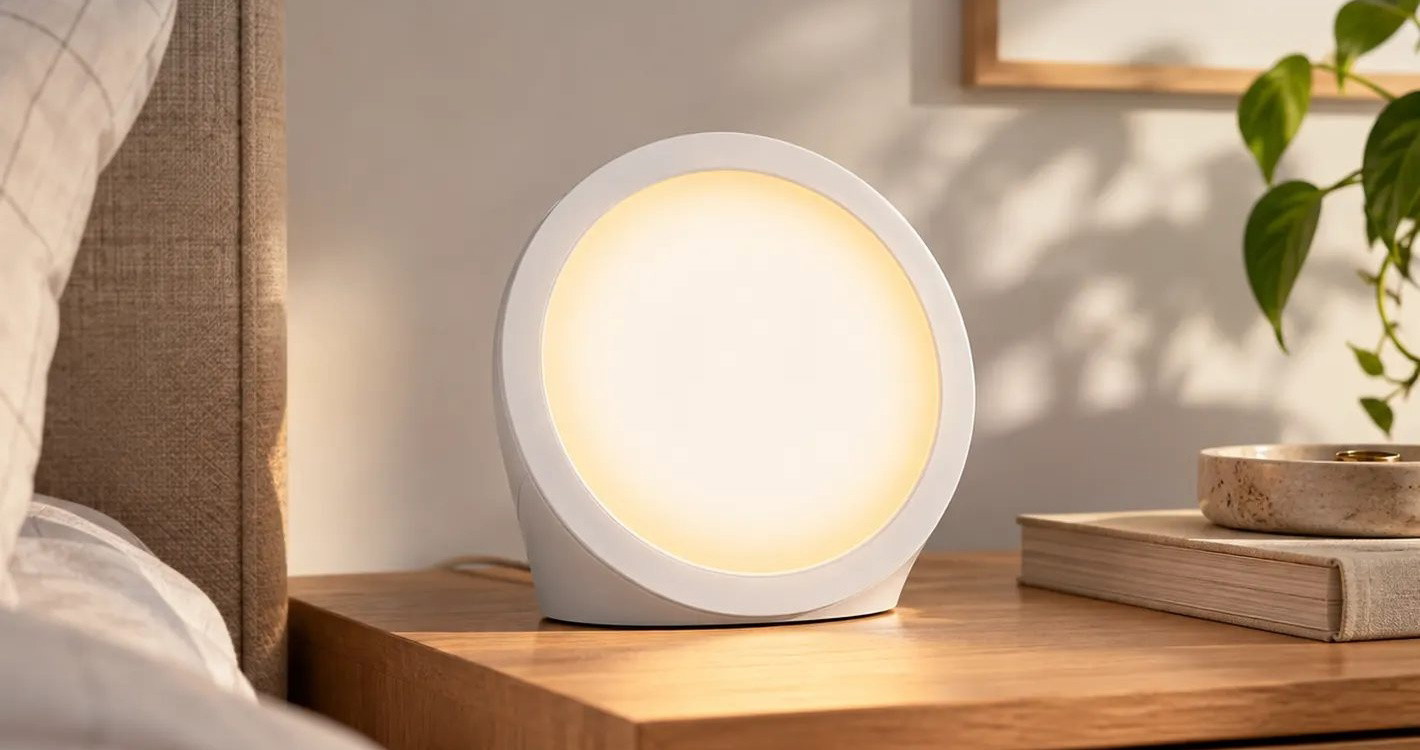
That is where a well-chosen lamp helps: something bright and welcoming when you get up, then something softer and warmer as the evening goes on. The Sunniva Lamp was designed as a lamp for mornings and evenings. Think of it as part of the routine above, alongside the open curtains and the morning walk, not as a substitute for them.
Bright mornings, dim evenings, dark nights. It's an old rhythm, and the research suggests it's worth bringing back. For more on setting up your bedroom, see our guide to sleeping cooler.
From the Sunniva collectionSunniva LampCool, bright light for mornings and warm, low light for evenings.View productSources
- National Institute of General Medical Sciences. "Circadian Rhythms." NIH.
- Wright KP Jr, McHill AW, Birks BR, Griffin BR, Rusterholz T, Chinoy ED. "Entrainment of the Human Circadian Clock to the Natural Light-Dark Cycle." Current Biology 23 (2013): 1554–1558.
- Dautovich ND, Schreiber DR, Imel JL, et al. "A systematic review of the amount and timing of light in association with objective and subjective sleep outcomes in community-dwelling adults." Sleep Health (2019; published online 2018).
- Gooley JJ, Chamberlain K, Smith KA, et al. "Exposure to Room Light before Bedtime Suppresses Melatonin Onset and Shortens Melatonin Duration in Humans." Journal of Clinical Endocrinology & Metabolism 96, no. 3 (2011): E463–E472.
- Brown TM, Brainard GC, Cajochen C, et al. "Recommendations for daytime, evening, and nighttime indoor light exposure to best support physiology, sleep, and wakefulness in healthy adults." PLOS Biology 20, no. 3 (2022): e3001571.
- Sleep Foundation. "What Is Circadian Rhythm?"
- Sleep Foundation. "Blue Light."
- Harvard Health Publishing. "Blue light has a dark side."
This article is for general information and isn't medical advice. Individual results vary.
