


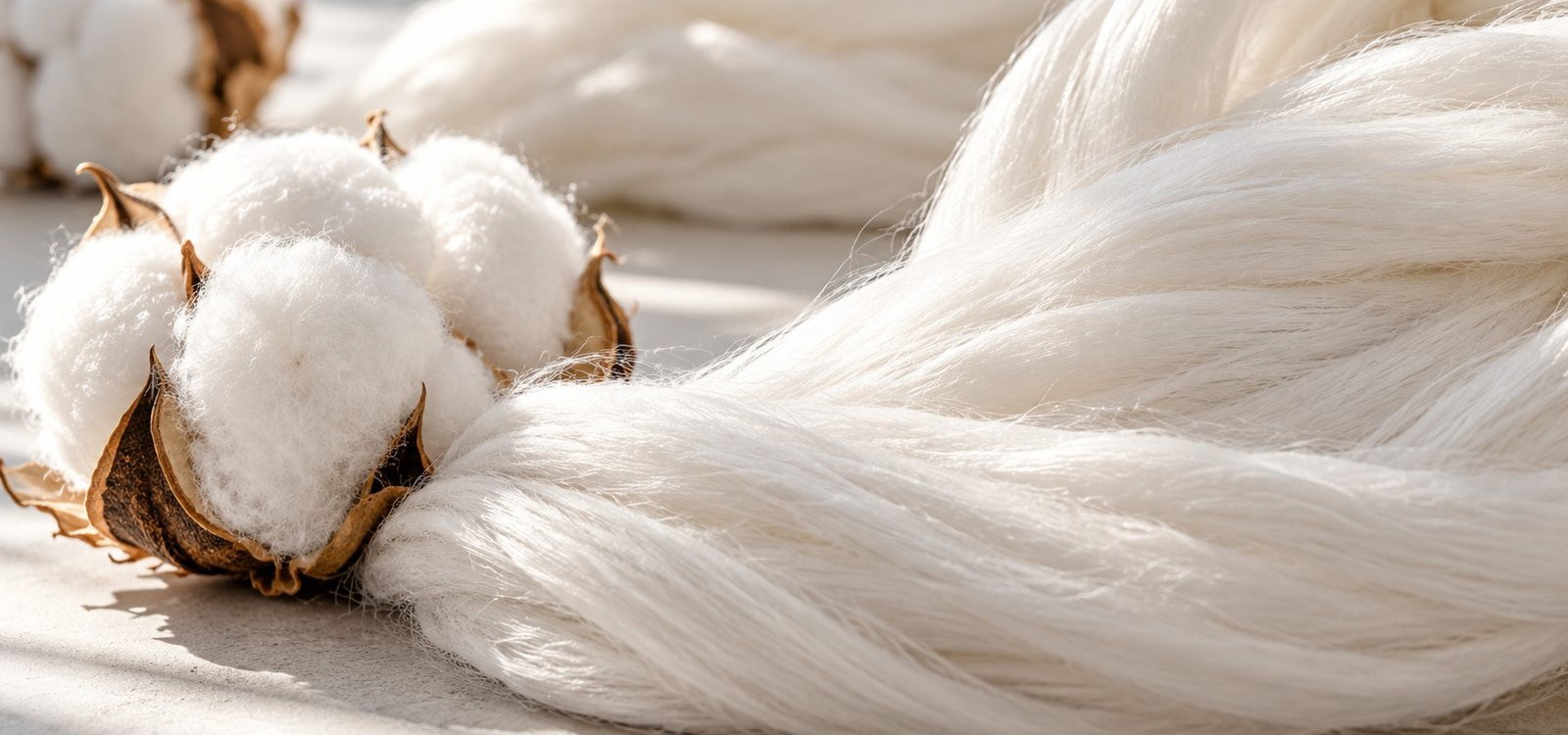
Pull a tuft from a cotton boll and stretch it gently, and you can see the individual fibers. Some are barely an inch long, and some are closer to an inch and a half. That small difference, called staple length, does a lot to decide whether a sheet stays smooth for years or turns fuzzy after a season.
Key points
- Staple is fiber length; the ICAC defines long staple as 1 1/8 to 1 5/16 inches, extra-long as 1 3/8 or more.
- Pima and Egyptian labels are often misused; the Supima trademark and the Cotton Egypt Association logo help verify claims.
- Longer fibers make stronger yarns with less hairiness, which has been tied to less pilling.
- Thread count is easy to inflate with plied yarns; a good single-ply 400 usually beats a stacked higher count.
Here is what staple length means, how the well-known cotton names relate to it, why thread count is a weaker signal than it seems, and what to look for when you shop.
What staple length means
"Staple" is the textile word for the length of a fiber. Cotton is graded on it, and there's no single worldwide scale, so cutoffs vary a little between systems. The International Cotton Advisory Committee defines long staple as 1 1/8 to 1 5/16 inches (29 to 33 mm) and extra-long staple, often shortened to ELS, as 1 3/8 inches (35 mm) or longer. In the U.S. classing categories, medium staple runs from about 0.94 to 1.13 inches (24 to 29 mm), and anything shorter counts as short staple.
Most of the world's cotton is upland cotton, Gossypium hirsutum, which typically falls in the medium range. The long and extra-long fibers mostly come from a different species, Gossypium barbadense, the source of Pima, Egyptian and Sea Island cottons. Most barbadense varieties qualify as extra-long staple, though some only reach long staple. Breeders have also developed some upland varieties with longer fibers, so the species name alone doesn't settle it.
Pima, Supima and Egyptian: what the names mean
Pima is American-grown extra-long staple cotton. According to Textile World, it was called "American-Egyptian" in the 19th century and was renamed Pima in 1910 to honor the Pima people, who grew it for the U.S. Department of Agriculture's breeding program. It needs a long, hot, dry season and full irrigation, so it's grown in the Southwest and Far West. Pima makes up about 3% of U.S. cotton and about 1% of the world's.
Supima is a trademark, not a variety. It is controlled by a nonprofit of the same name founded in 1954, and only licensed companies may use it, for products made from American Pima. Supima fibers average more than 1 7/16 inches. The distinction matters because "Pima" itself isn't a trademark, so anyone can print it on a label. In 2015, Supima's executive vice president, Marc Lewkowitz, reported that the group had DNA-tested 40 retail products labeled as Pima. About 10% were pure Pima. Roughly two-thirds were blends with upland cotton, and about a quarter contained no Pima at all.
Egyptian cotton means cotton grown in Egypt, which has a long reputation for fine, long fibers. The name has been misused often. In 2016, Target cut ties with the Indian manufacturer Welspun after finding that about 750,000 sheets and pillowcases sold as Egyptian cotton were made from other, cheaper fibers. The Cotton Egypt Association, a nonprofit founded in 2005, licenses the official Egyptian Cotton logo and uses audits and DNA testing to check products that carry it. If an "Egyptian cotton" label matters to you, look for that logo.
Why long fibers make a better yarn
Yarn is made by twisting fibers together. Longer fibers overlap more along the length of the yarn, so each one is held more firmly, and there are fewer fiber ends per inch. That shows up in measurable ways. A study in the Journal of Cotton Science by C. Wayne Smith and colleagues, published in 2025 and based on data collected from 2013 to 2018, found that fiber length, along with strength and fineness, was highly correlated with yarn strength.
Short fibers are harder to bind into the body of a yarn, and their ends tend to stick out. Spinning research has linked longer fibers and lower short-fiber content to less "hairiness," the fuzz of protruding ends on a yarn. Hairiness in turn has been tied to pilling: those loose ends rub, tangle and roll into the little balls you find on old sheets. Long fibers also let mills spin finer yarns, which can be woven into a smoother, lighter fabric.
Fiber length isn't the whole story, though. Spinning method, weave, finishing and care all affect how a sheet feels and lasts.
The trouble with thread count
Thread count is the number of lengthwise and crosswise yarns in a square inch of fabric. A higher number can mean a finer, denser weave, but it's easy to inflate. Some yarns are "plied," made from two or more strands twisted together, and some sellers count each strand separately to double the number.
The industry standard from ASTM counts a plied yarn as one yarn. In a 2005 staff letter, the Federal Trade Commission said that inflating a thread count by multiplying it by the number of plies could deceive consumers, and suggested labeling such as "300 thread count, two-ply yarn." By that logic, a sheet sold as "800 thread count" with two-ply yarns is really a 400. A 400 thread count woven from good single-ply, long-staple yarn will usually feel better and wear longer than a much higher count made by stacking thin, weak yarns.
From the Equilibrium collectionEquilibrium Grounding Fitted SheetGOTS certified organic cotton at 400 thread count, with conductive silver fiber woven in.View productWhat "organic" means for cotton
"Organic" describes how the cotton was grown, not how long its fibers are. In the U.S., organic crops fall under the USDA's National Organic Program. Its rules require that the land have had no prohibited substances, such as most synthetic pesticides and fertilizers, applied for three years before harvest. The program covers how the fiber is grown, but it has no specific standards for processing it into fabric.
That gap is one reason the Global Organic Textile Standard, or GOTS, exists. It follows the fiber through spinning, weaving, dyeing and finishing. Its "organic" label grade requires at least 95% certified organic fiber, and its "made with organic" grade requires at least 70%. The USDA says textiles certified to GOTS may be sold as organic in the U.S., though they can't carry the USDA seal unless they also meet USDA rules.
Either way, the fiber does the quiet work long before the label does.
How to judge a sheet, and keep it good
- Read the fiber, not just the number. "Long-staple" or "extra-long staple" tells you more than a big thread count. For Pima, Supima or Egyptian claims, look for the licensed trademark or logo.
- Check the ply. If a very high thread count is listed, see whether the yarn is single-ply or multi-ply.
- Feel the hand. A good sheet feels smooth and even, with little surface fuzz, even before washing.
- Look for real certifications. A certificate number you can check online is worth more than a vague "natural" or "eco" claim.
Care matters as much as fiber. Velin's Care Guide recommends washing sheets in cold water on a gentle cycle with a mild detergent, then tumbling dry on low or line drying. Skip bleach, fabric softener and dryer sheets. Heat and harsh agitation wear fibers down faster, and pilling often starts with rough washing and over-drying.
At Velin, these choices show up in two places. Our Equilibrium Grounding Fitted Sheet and Equilibrium Grounding Pillowcase are made from GOTS certified organic cotton at 400 thread count, with conductive silver fiber woven in. SilverThread Sheets use GOTS certified organic long-staple cotton in a twill weave, with silver bonded at the fiber level; you can read why in Why Silver? Either way, the fiber does the quiet work long before the label does.
Sources
- "Staple (textiles)," including ICAC and U.S. classing definitions. wikipedia.org
- Textile Exchange. "Fiber Length" (glossary). textileexchange.org
- Textile World. "Five Surprising Facts About Supima Cotton," 2017. textileworld.com
- Farm Progress. "If it says 100 percent Pima, it likely isn't," November 2015. farmprogress.com
- Fibre2Fashion. Interview with Marc A. Lewkowitz, Supima. fibre2fashion.com
- Associated Press via Indianapolis Business Journal. "Dirty linen: Bed sheets scandal roils major U.S. retailers," 2016. ibj.com
- Cotton Egypt Association. "Our Egyptian Cotton Accreditation Procedure." cottonegyptassociation.com
- Smith CW, Hugie K, Schumann M, Hague S. "Correlation of Cotton Fiber Properties with Yarn Tenacity at Varying Levels of Fiber Length and Strength." Journal of Cotton Science, 2025;29(1):48–55. cotton.org
- "Effect of Fiber Length and Short Fiber Percent in Cotton on Fiber and Yarn Quality." Egyptian agricultural science journal (Egyptian Knowledge Bank). journals.ekb.eg
- IDFL. "Thread Count: ASTM Definitions." idfl.com
- Home Textiles Today. "Thread count game slammed by FTC," September 2005. hometextilestoday.com
- 7 CFR § 205.202, Land requirements (USDA National Organic Program). law.cornell.edu
- USDA National Organic Program. Policy Memo 11-14, "Labeling of Textiles That Contain Organic Ingredients." usda.gov
- Global Organic Textile Standard. "Label Grades." global-standard.org
